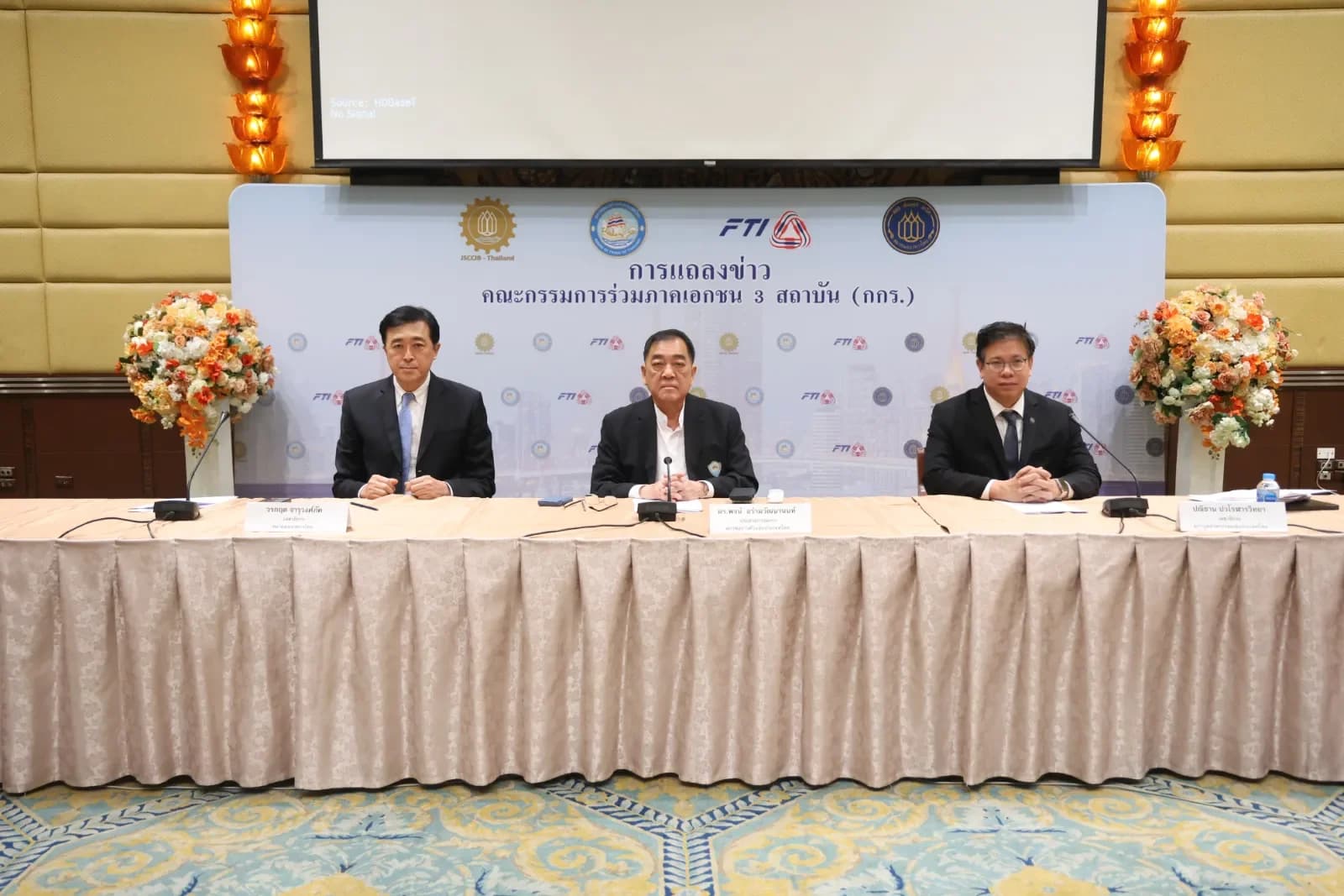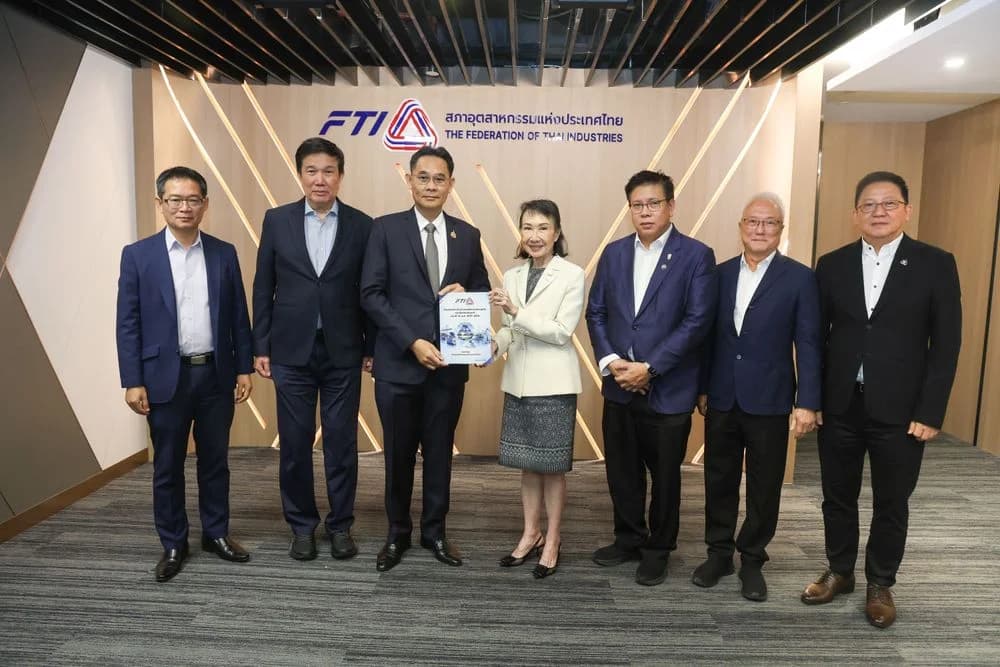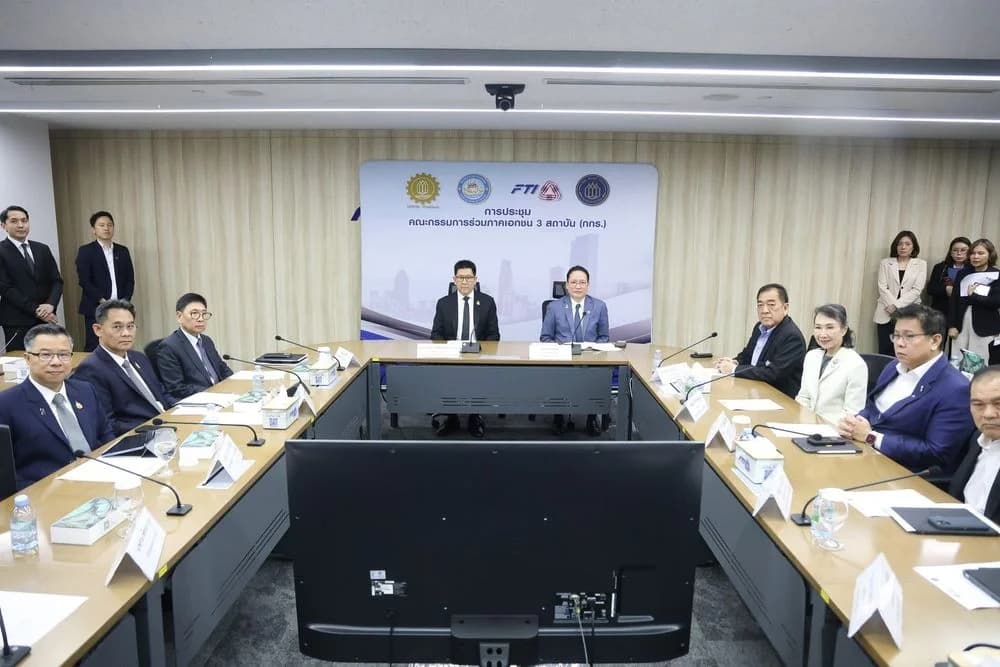

วันพุธที่ 7 สิงหาคม 2567 นายผยง ศรีวณิช ประธานสมาคมธนาคารไทย เป็นประธานการประชุมคณะกรรมการร่วมภาคเอกชน 3 สถาบัน (กกร.) โดยมีนายเกรียงไกร เธียรนุกุล ประธานสภาอุตสาหกรรมแห่งประเทศไทย (ส.อ.ท.) และนายสุรงค์ บูลกุล รองประธานกรรมการสภาหอการค้าไทย ร่วมในการแถลงข่าว
เศรษฐกิจโลกยังคงอยู่ในภาวะชะลอตัว เครื่องชี้ด้านการผลิต PMI Manufacturing เดือนกรกฎาคมของประเทศหลักทั้งสหรัฐฯ ยุโรป ญี่ปุ่น และจีน ต่างหดตัว โดยที่กำลังซื้อในประเทศของจีนยังชะลอตัว ขณะที่สหรัฐฯ กำลังเผชิญกับตลาดแรงงานที่แผ่วลงกดดันการบริโภคในระยะข้างหน้า กระทบกับครึ่งปีหลัง ถือเป็นความท้าทายต่อการส่งออกสินค้าของไทย ซึ่งขยายตัวได้เพียง 2% ในช่วงครึ่งปีแรก ขณะที่ภาวะตลาดการเงินโลกเกิดความผันผวน ทั้งเฟดส่งสัญญาณลดอัตราดอกเบี้ยนโยบายเร็วและแรงขึ้น สวนทางกับธนาคารกลางญี่ปุ่นที่ปรับเพิ่มอัตราดอกเบี้ย โดยรวมทำให้ค่าเงินบาทแข็งค่าขึ้นอย่างรวดเร็ว
ส่วนแบ่งตลาดของสินค้าอุตสาหกรรมไทยในอาเซียนลดลง ส่วนแบ่งตลาดส่งออกในอาเซียนของไทยลดลงในกลุ่มเครื่องใช้ไฟฟ้าจาก 12.7% (1Q/66) เหลือ 11.5% (1Q/67) และยานยนต์ลดลงจาก 20.9% (1Q/66) เหลือ 18.7% (1Q/67) เป็นผลจากที่จีนได้ส่งออกสินค้ามาแข่งขันในตลาดอาเซียนมากขึ้น โดยเป็นปัจจัยหนึ่งที่ทำให้การผลิตภาคอุตสาหกรรม 6 เดือนแรกของปีหดตัว 1.8% นอกจากนี้ยังมีความเสี่ยงเพิ่มเติมจากการรุกตลาดอีคอมเมิร์ซของสินค้าจีน
เศรษฐกิจไทยในระยะข้างหน้ายังเปราะบางแม้การเบิกจ่ายงบประมาณของรัฐจะเริ่มนำเม็ดเงินเข้ามาสู่ระบบเศรษฐกิจมากขึ้น การเร่งเบิกจ่ายงบประมาณทำให้การใช้จ่ายของรัฐกลับมาขยายตัวเฉลี่ยสูงกว่ากว่า 15% ในเดือนพฤษภาคม-มิถุนายน อย่างไรก็ตาม อุปสงค์ภายในประเทศชะลอตัวสะท้อนจากยอดโอนอสังหาฯ 5M/67 หดตัว -8.8% ยอดจำหน่ายรถยนต์ 6M/67 หดตัวต่อเนื่องที่ -24%YoY และการส่งออกที่ยังขยายตัวได้น้อย ทำให้เศรษฐกิจไทยมีแนวโน้มขยายตัวได้ต่ำกว่าศักยภาพแม้ว่าภาคการท่องเที่ยวจะทยอยกลับมาฟื้นตัว
กรอบประมาณการเศรษฐกิจปี 2567 ของ กกร.
(ณ มิ.ย. 67) ปี 2567
GDP 2.2 ถึง 2.7
ส่งออก 0.5 ถึง 1.5
เงินเฟ้อ 0.5 ถึง 1.0
(ณ ก.ค. 67) ปี 2567
GDP 2.2 ถึง 2.7
ส่งออก 0.8 ถึง 1.5
เงินเฟ้อ 0.5 ถึง 1.0
(ณ ส.ค. 67) ปี 2567
GDP 2.2 ถึง 2.7
ส่งออก 0.8 ถึง 1.5
เงินเฟ้อ 0.5 ถึง 1.0
กกร. มีความกังวลต่อการขาดดุลการค้าระหว่างไทยกับจีน ที่ล่าสุด 6 เดือนแรกของปี 2567 มีการนำเข้าสินค้าจากจีนเพิ่มขึ้นถึง 7.12%YoY คิดเป็นมูลค่ากว่า 37,569.89 ล้านดอลลาร์สหรัฐ ส่งผลให้ไทยขาดดุลการค้าจากจีน -19,967.46 ล้านดอลลาร์สหรัฐ เพิ่มขึ้น 15.66%YoY ซึ่งส่งผลกระทบกับภาคการผลิตกว่า 23 กลุ่มอุตสาหกรรม อีกทั้งยังถูกซ้ำเติมจาก Platform e-commerce ที่เข้ามาเปิดตลาดในประเทศโดยขายสินค้าจากโรงงานตรงสู่ผู้บริโภคในราคาถูก ซึ่งเป็นการค้ารูปแบบใหม่ของจีน ยิ่งกดดันผู้ประกอบการ SMEs เนื่องจากไม่สามารถแข่งขันทั้งด้านราคา และต้นทุนการผลิตที่สูงกว่าได้ ดังนั้นเพื่อให้ผู้ประกอบการไทยแข่งขันได้ ภายใต้เมกะเทรนด์ของโลกที่มีสินค้าไม่ได้คุณภาพเข้ามาตีตลาดจากภาวะ Over Supply ที่ประชุมกกร. จึงขอเสนอให้รัฐบาลเข้มงวดการตรวจสอบมาตรฐานสินค้านำเข้า กำกับและควบคุมสินค้าที่หลีกเลี่ยงภาษี โดยบังคับใช้กฎหมายที่เกี่ยวข้องกับการค้าภายในประเทศอย่างเข้มข้น โดยสร้าง Ecosystem ที่ทำให้ผู้ประกอบการไทย และ Supply Chain ไทยมีความเข้มแข็งและแข่งขันได้อย่างยั่งยืน ทั้งนี้ สภาหอการค้าแห่งประเทศไทย หอการค้าไทย-จีน และ สถานเอกอัครราชทูตสาธารณรัฐประชาชนจีนประจำประเทศไทย ได้มีการจัดตั้งศูนย์ประสานงานและส่งเสริมธุรกิจไทย-จีน อย่างยั่งยืน (Thai-Chinese Center for Business Sustainability (TCCBS)) เพื่อแก้ไขปัญหาการค้าและการลงทุน ระหว่างไทยและจีน ให้อยู่ในกรอบของผลประโยชน์ร่วมกันภายใต้กรอบของกฎหมายของทั้งสองประเทศและกติกาสากล
ในที่ประชุม กกร. ได้แสดงความห่วงใยถึงสถานการณ์ภาคการผลิตที่หดตัว ถึงแม้ว่า 6 เดือนแรกของปี 2567 จะมีจำนวนการเปิดโรงงานขยายตัวต่อเนื่อง โดยมีโรงงานเปิดกิจการกว่า 1,009 แห่ง เพิ่มขึ้น 122.67%YoY ซึ่งพบว่าส่วนใหญ่เป็นนักลงทุนต่างชาติที่เข้ามาลงทุนผ่าน BOI แต่ในขณะเดียวกัน จากข้อมูลของกรมโรงงานอุตสาหกรรมพบว่ามีโรงงานปิดตัวเพิ่มขึ้นในครึ่งปีแรกแล้วกว่า 667 แห่ง เพิ่มขึ้นจากปีก่อนหน้า +86.31%YoY หรือเฉลี่ย 111 แห่ง/เดือน และหากพิจารณามูลค่าโรงงานต่อโรงที่ปิดตัว พบว่ามีเงินทุนลดลงเหลือเฉลี่ย 27.12 ล้านบาทต่อโรงงาน ซึ่งสะท้อนให้เห็นว่าส่วนใหญ่เป็นโรงงานขนาดเล็ก หรือ SMEs ที่มีการปิดโรงงานในอัตราส่วนที่เร่งขึ้น ดังนั้น กกร. จึงอยู่ระหว่างเตรียมข้อเสนอเพื่อส่งเสริมอุตสาหกรรม อาทิ การส่งเสริมสินค้าที่ผลิตภายในประเทศ (Made in Thailand) เพื่อช่วยจัดสรรเม็ดเงินลงระบบในราย Sector การสนับสนุนอุตสาหกรรมชิ้นส่วนยานยนต์เพื่อรองรับ EV และ Transform ไปยังธุรกิจใหม่ การส่งเสริม SMEs การบริหารจัดการ waste ของภาคอุตสาหกรรม และการพัฒนากำลังคนเพื่อรองรับ Industry 4.0
จากการที่รัฐมีข้อสังเกตว่าเศรษฐกิจไทยมีการลงทุนน้อย มีสัดส่วนการลงทุนต่อ GDP ต่ำกว่า 25% ลดลงจากที่เคยสูงเกือบ 30% ในขณะที่มีการออมในระดับสูงจากการเกินดุลบัญชีเดินสะพัดอย่างต่อเนื่อง และมีเงินทุนไหลออกไปลงทุนต่างประเทศมากขึ้นซึ่งเป็นการเสียโอกาสในการนำเม็ดเงินมาลงทุนปรับโครงสร้างการผลิตและยกระดับประสิทธิภาพการผลิตภายในประเทศ ที่ประชุม กกร. เห็นตรงกับภาครัฐว่าประเทศไทยจำเป็นต้องลงทุนเพื่อเพิ่มศักยภาพในการแข่งขันกับประเทศเพื่อนบ้าน โดยเสนอให้ภาครัฐมีมาตรการสนับสนุนทางภาษีอย่างเป็นรูปธรรม เพื่อส่งเสริมการลงทุนในเมืองรองและสนับสนุนการลงทุนโดยใช้วัตถุดิบภายในประเทศ (local content) ส่งเสริมให้เกิดการลงทุนวิจัยและพัฒนาในอุตสาหกรรมสมัยใหม่ การลงทุนด้านโครงสร้างพื้นฐานเพื่อรองรับเมกะเทรนด์ การลงทุนเพื่อรองรับสังคมคาร์บอนต่ำ รวมถึงปรับปรุงหลักเกณฑ์และกฎหมายเพื่อลดอุปสรรคในการทำธุรกิจ (Ease of doing business) และความพร้อมเรื่องทรัพยากรบุคคล
สถานการณ์หนี้ครัวเรือนยังมีความน่ากังวล ตัวเลขหนี้เสีย (NPL) ที่รายงานโดยเครดิตบูโรยังมีการเพิ่มขึ้นต่อเนื่อง ล่าสุดเดือนพฤษภาคมสูงถึง 1.14 ล้านล้านบาท เพิ่มขึ้น 11%YoY สะท้อนภาพการฟื้นตัวของรายได้ที่ยังไม่ทั่วถึง ที่ประชุม กกร. เห็นว่ามีความจำเป็นที่รัฐจะเร่งรัดผันเม็ดเงินสู่ระบบเศรษฐกิจโดยที่ส่วนหนึ่งมุ่งเน้นการยกระดับกลุ่มฐานราก และภาคการผลิต ใน Real Sector ให้มีความสามารถในการแข่งขัน และสร้างรายได้ให้กับกิจการและแรงงานตลอด Supply Chain อย่างแท้จริง ควบคู่ไปกับการกระตุ้นให้ลูกหนี้และภาคธุรกิจเข้าร่วมการปรับโครงสร้างหนี้หรือรวมหนี้เพื่อลดภาระหนี้ให้เหมาะสมกับรายได้
ที่ประชุม กกร. เห็นว่าการเร่งรัดเบิกจ่ายงบประมาณในช่วงที่เหลือของปีเป็นความจำเป็นเร่งด่วนโดยเฉพาะการกระตุ้นกิจกรรมก่อสร้างภาครัฐให้กลับคืนมา ซึ่งจะช่วยหนุนภาคเศรษฐกิจที่เกี่ยวเนื่องรวมทั้งการจ้างงานให้ฟื้นตัวดีขึ้นโดยเร็ว เติมสภาพคล่องในระบบเพื่อสนับสนุนกำลังซื้อที่อ่อนแอ นอกจากนี้ยังมีข้อเสนอว่า ภาครัฐควร นำเทคโนโลยี เช่น Block Chain มาพัฒนากระบวนการจัดซื้อจัดจ้างออนไลน์ ตาม พ.ร.บ. จัดซื้อจัดจ้างฯ พ.ศ. 2560 ให้มีประสิทธิภาพ โปร่งใส สามารถติดตามสถานะได้ตลอดเวลา ช่วยควบคุมการรั่วไหลข้อมูลด้านราคา ป้องกันการสมยอมกันระหว่างหน่วยงานกับผู้ขาย หรือการสมยอมกันในหมู่ผู้ขาย
On Wednesday, August 7, 2024, Mr. Payong Srivanich, Chairman of the Thai Banks Association, presided over a meeting of the Joint Committee of the Private Sector 3 Organizations (JCC), with Mr. Kriangkrai Theeranukul, Chairman of the Federation of Thai Industries (FTI), and Mr. Surong Boolkul, Vice Chairman of the Thai Chamber of Commerce, participating in the press conference.
The global economy remains sluggish, as evidenced by the PMI Manufacturing index for July in major countries including the United States, Europe, Japan, and China, which all contracted. Meanwhile, domestic purchasing power in China is still slowing down, while the U.S. faces a weakening labor market that may pressure consumption in the near future, impacting the second half of the year. This presents a challenge for Thai exports, which grew by only 2% in the first half of the year. Additionally, the global financial market is experiencing volatility, with the Federal Reserve signaling a faster and stronger reduction in policy interest rates, in contrast to the Bank of Japan, which has raised interest rates, leading to a rapid appreciation of the Thai baht.
The market share of Thai industrial products in ASEAN has declined. Thailand's export market share in ASEAN for electrical appliances decreased from 12.7% (Q1/2023) to 11.5% (Q1/2024), and in the automotive sector from 20.9% (Q1/2023) to 18.7% (Q1/2024). This is due to increased competition from Chinese exports entering the ASEAN market, contributing to a 1.8% contraction in industrial production during the first six months of the year. Furthermore, there are additional risks from the e-commerce market encroachment by Chinese products.
The Thai economy in the near term remains fragile, even as government budget disbursements have begun injecting more funds into the economy. Accelerated budget disbursement has resulted in an average increase in government spending of over 15% in May-June. However, domestic demand is slowing as evidenced by a -8.8% contraction in real estate transfers in the first five months of 2024, continuous decline in vehicle sales at -24% YoY, and minimal export growth, suggesting that the Thai economy is likely to grow below its potential, even as the tourism sector gradually recovers.
The JCC's economic projections for 2024 are as follows:
(as of June 2024) 2024
GDP 2.2 to 2.7
Exports 0.5 to 1.5
Inflation 0.5 to 1.0
(as of July 2024) 2024
GDP 2.2 to 2.7
Exports 0.8 to 1.5
Inflation 0.5 to 1.0
(as of August 2024) 2024
GDP 2.2 to 2.7
Exports 0.8 to 1.5
Inflation 0.5 to 1.0
The JCC is concerned about the trade deficit between Thailand and China, with imports from China increasing by 7.12% YoY in the first six months of 2024, amounting to over 37,569.89 million USD. This has resulted in a trade deficit with China of -19,967.46 million USD, an increase of 15.66% YoY, impacting over 23 industrial sectors. Additionally, it is compounded by e-commerce platforms that have entered the domestic market by selling products directly from factories to consumers at lower prices, which represents a new form of trade from China that further pressures SMEs, who struggle to compete with higher production costs. Therefore, to enhance the competitiveness of Thai businesses amid the global mega-trends where substandard products are flooding the market due to oversupply, the JCC proposes that the government intensify inspections of import product standards, enforce regulations concerning domestic trade, and build an ecosystem that strengthens Thai entrepreneurs and supply chains for sustainable competitiveness. Additionally, the Thai Chamber of Commerce, the Thai-Chinese Chamber of Commerce, and the Embassy of the People's Republic of China in Thailand have established the Thai-Chinese Center for Business Sustainability (TCCBS) to address trade and investment issues between Thailand and China within a framework benefiting both parties under the laws and international regulations of both countries.
During the JCC meeting, concerns were raised regarding the contracting manufacturing sector. Even though the first six months of 2024 saw a continuous expansion in new factory openings, with over 1,009 factories commencing operations, representing a 122.67% YoY increase, most of these are foreign investments through the Board of Investment (BOI). Meanwhile, data from the Department of Industrial Works indicate that 667 factories closed in the first half of the year, up from the previous year by 86.31% YoY, averaging 111 closures per month. Furthermore, data on the investment value of closed factories show a decline to an average of 27.12 million Baht per factory, indicating that many closures involve small-sized factories or SMEs, which are shutting down at an increasing rate. Therefore, the JCC is preparing proposals to promote industries, such as supporting domestically produced goods (Made in Thailand) to help channel funds into the economy sector-wise, support the automotive parts industry for EV readiness, transform to new businesses, promote SMEs, manage industrial waste, and develop manpower to support Industry 4.0.
Due to government observations that Thailand's investment is low, with investment-to-GDP ratios below 25%, down from nearly 30%, while high savings continue due to consistent current account surpluses, and more funds flowing out to invest abroad, which represents lost opportunities for domestic production restructuring and efficiency improvements. The JCC concurs with the government that Thailand needs to invest to enhance competitiveness with neighboring countries and recommends that the government implement concrete tax incentives to promote investment in secondary cities and support investments using local raw materials. Moreover, it advocates for increased investment in research and development in modern industries, infrastructure investment to accommodate mega-trends, investments to support a low-carbon society, as well as improvements to regulations and laws to ease business operations (Ease of doing business) and ensure resource availability.
The household debt situation remains concerning, with Non-Performing Loan (NPL) figures reported by the credit bureau continuously rising, reaching 1.14 trillion Baht in May, a 11% YoY increase, reflecting the uneven recovery of incomes. The JCC believes it is essential for the government to expedite the flow of funds into the economy, focusing on upgrading the base economic group and the manufacturing sector in the real economy to enhance competitiveness and generate sustainable income across the entire supply chain, alongside encouraging debtors and businesses to participate in debt restructuring or consolidation to align their debt burdens with their income levels.
The JCC believes that accelerating budget disbursement for the remainder of the year is an urgent necessity, particularly to stimulate public construction activities to boost the related economic sectors and enhance employment recovery, thereby improving liquidity in the system to support weak purchasing power. Additionally, it has been proposed that the government should adopt technologies, such as Blockchain, to develop the online procurement process under the Public Procurement Act BE 2560 for efficiency, transparency, and real-time status tracking, helping control data leakage regarding pricing and preventing collusion among agencies and vendors or collusion among vendors.